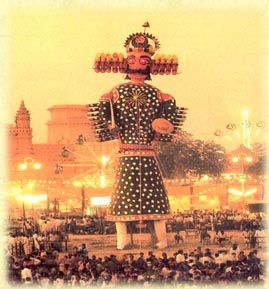
Dussehra is the culmination of Navaratis in India. Popularly known as Vijayadashmi, Dussehra is celebrated with great enthusiasm, all over India. It is observed differently in different parts of the country, depending upon the legend that is followed in each region. In North India, Ramlila forms the highlight of Dusshera, while in south India, it is the triumph of Goddess Durga over Mahishasura that is celebrated. Eastern state of West Bengal has its own story connected to the festival, while in Mysore the concept of Shami tree is centered. Learn about the celebrations of Dussehra in different parts of India, by going through the following lines.
Dusshera Celebrations In India
In North India
Ramlila is the backbone of the celebration of Dusshera in northern India, where the scenes from Rama's life are depicted, especially Bharat Milap, the reunion of Rama with his brother Bharat, the destruction of Ravana (the highlight of Dussehra) and the return of Rama, Lakshmana and Sita to Ayodhya, their kingdom after fourteen years of exile. In Himachal Pradesh's Kulu valley, the very ceremonial festivities and grand processions of the village deities of the hill people marks Dussehra.
In Delhi and nearby states, oversized effigies of Ravana, Meghnath and Kumbhkaran are burnt in Ramlila, a mela that is organized by different committees, at huge grounds. It is a week long affair in the hill town of Kullu, in Himachal Pradesh. Deities are brought in process to 'maidan' in Kullu, to pay respect to the reigning deity of the place - Raghunathji. The huge procession consists of more than hundred deities that are mounted on the colorful palanquins. Ramlila is the next major attraction of Kullu Dusshera.
In South India
In Tamil Nadu, the nine days preceding Dussehra have been equally divided for worshipping the three Goddesses namely Lakshmi (the first three days are dedicated to the Goddess of wealth and prosperity), Saraswati (the next three days are dedicated to the Goddess of learning and arts) and Durga (the last three days are dedicated to Mother Goddess, Shakti). The women and children of Tamil Nadu, Andhra Pradesh and Karnataka arrange small statues and dolls, known as 'Bommai Kolu', on artificial steps and decorate the steps and the nearby place with beautiful lamps and flowers.
From the very first day of the festival, songs and stories form a part of the celebration and a dish made out of chickpeas known as 'choondal' is made for the dolls as prasad to relish on. Vijayadashmi is the day when the Bommai Kolu is taken down ceremoniously. On the day of Vijayadashami, vidya aarambh (vidyaarambam) is observed. The day is considered very auspicious, especially for the children to begin their education in academics as well as art. Saraswati puja is done on Vijayadashami. A similar tradition can be seen in Kerala as well.
Mysore is famous for a gala procession of richly bedecked elephants on the brightly lit streets of the city on Dussehra. In Mysore, effigies of Ravana, Meghnath and Kumbhkaran are burnt. The Mysore palace is illuminated for a whole month during the festive season of Dussehra. Caparisoned elephants lead a colorful procession through the vibrantly decorated streets of the princely city. In Andhra Pradesh, Dussehra is popularly referred to as Dasara.
In East India
In the eastern state of West Bengal, Vijayadashmi is celebrated as the victory of Goddess Durga over Mahishasura, the demon who ruled the swarglok and the earth with his invincible power. It is the last day of the ten-day festival - Durga Puja. On Vijayadashmi, the idol of Ma Durga is immersed in the nearby river or lake ceremoniously, by the devotees. This is called visarjan (submersion of diety). The idol is preceded by a huge procession of devotees. In Orissa, the festival is called Vijoya Dashami. The day is considered the last day of the Sharodiya Durga Puja. After offering the last ritual (Aparajita Puja) to the Goddess, a tearful farewell is bid to her. The immersion of diety is known as 'Bisarjan Jatra'. After immersing the idol, people in Orissa celebrate 'Ravan Podi', wherein the effigies of demon Ravana are burnt.
In West India
In Maharashtra, Dussehra is celebrated on the tenth day of the Ashwin month, as per the Shaka Hindu Calendar. On the last day of Navratri, that is Dussehra, the idols installed on the first day of Navratri are immersed in water. Dussehra marks the victory of Lord Rama over Ravana. People celebrate the occasion with fun and fervor. They visit their friends and relatives and exchange sweets. Aapta tree is worshipped on this day. Exchange of leaves of aapta tree is considered auspicious. The legend of Shami tree, under which the Pandavas of Mahabharata stored their weapons during their 12 years of exile, is associated with the celebrations. As per the legend, the weapons were retrieved by them on this day. Dussehra is considered auspicious to start any new venture, according to the Maharashtrians